Give a short about section and my supervisors. Talk about how the plots are
made with Julia. Give an example interactive plot with instructions on how
to pan and rotate it. Link a github when i make that and the paper when its
published
testing in line latex - Burgers equation $u_t + u u_x = \mu u_{xx}$.
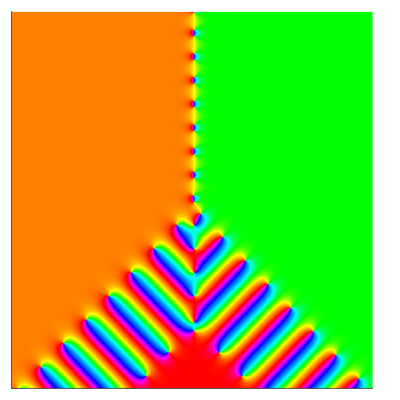
Figure 1: (a) real-valued solution profiles of
Burgers' equation with $\mu = 1$ for various times using step down
IC (solid lines), together with the travelling wave
solution (dashed line) and the small-time approximation (dash dot line).
(b) phase portrait of this solution at $t = 1$. (c) zoomed in version
of (b) to show coloured phases more clearly, where white arrows point
to zeros and black arrows point to poles. (d) real solution profiles
with $\mu = 1$ using step up IC (solid lines) together
with small-time approximation (dash dot line, note that this is extremely
close to the orange line at $t = 0.5$). (e) and (f) phase portraits of
this solution at t = 1 with $\mu = 1$.
testing html plotting
Figure 2: Interactive landscape plot for
Burgers' equation with the step down IC at $t = 1$ and $\mu = 1$.
Figure 3: Interactive landscape plot for
Burgers' equation with the step up IC at $t = 1$ and $\mu = 1$.
testing video
The $\mathrm{Re}(x)$ and $\mathrm{Im}(x)$ axis scale with $\sqrt{t}$ while the
$\left|u(x,t)\right|$ axis scales with $5\sqrt{10/t}$ somewhat arbitrarily.
The $\mathrm{Re}(x)$ axis also moves at the travelling wave speed $t/2$.
At $t = 10$ the $\left|u(x,t)\right|$ fixes at a magnitude of 5.
Then at $t = 144$ the $\mathrm{Re}(x)$ and $\mathrm{Im}(x)$ axis stops scaling and
only the $\mathrm{Re}(x)$ axis moves at the travelling wave speed $t/2$.
Unfortunately the landscape plot has numerical accuracy issues until about
$t = 10^{-12}$ due to the extreme ratio between the $\mathrm{Re}(x)$ and $\mathrm{Im}(x)$ axis
with the $\left|u(x,t)\right|$ axis. The domain length of $\mathrm{Re}(x)$ and $\mathrm{Im}(x)$
is also cut in half in the landscape plot just to make it visually easier to see the spikes
of the poles and the dips of the zeros.
Figure 4: Top left real solution for the step down IC over time.
Bottom left phase portrait of the same solution over time.
Center right landscape plot of the same solution over time where the black line
indicates the real line solution profile.
Figure 5: Top left real solution for the step up IC over time.
Bottom left phase portrait of the same solution over time.
Center right landscape plot of the same solution over time where the black line
indicates the real line solution profile.